

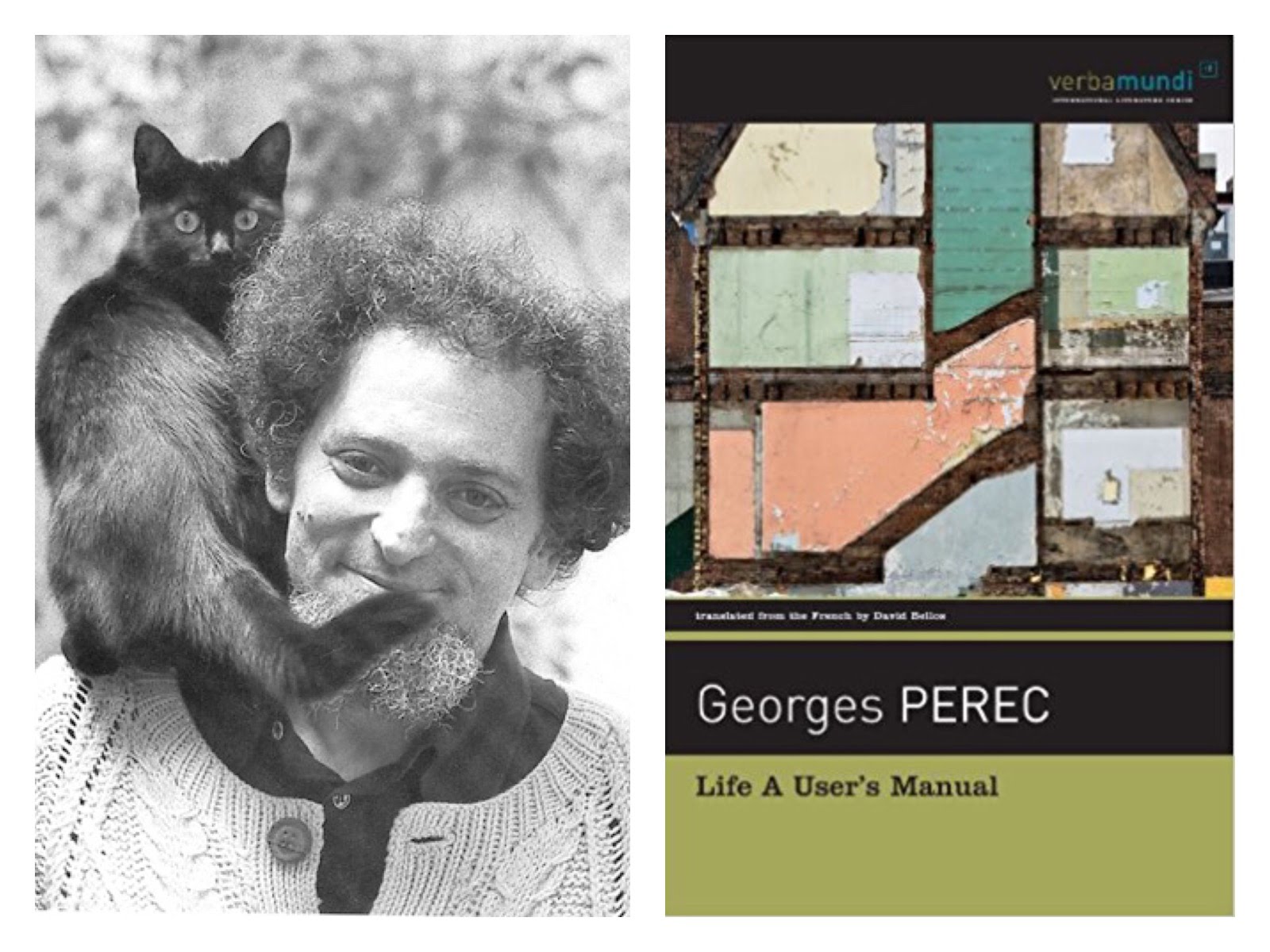
Life A User’s Manuel by Georges Perec is a fascinating novel entirely taking place at eight p.m June 23, 1975 in a hundred unit apartment house in Paris. For sure it is very creative, at times amazing. Maybe those who call it one of The greatest novels written since World War II and call it a work of genius are right. Leaving that question for others, for sure it is the product of extreme high intelligence deeply focused. Nine years in the making, it tells the story of the residents of the building in 99 chapters and an epilogue. It might seem as you read it to be mainly a series of stories, some really interesting going deeply into the residents lives with wonderful descriptions of furniture, art, food, relationships and much more. Everything is all tied together. The book abounds with hidden and real puzzles, literary references, artistic allusiions, some real some who knows. Culturally this is a very rich book. It will leave many readers, as it did me, stunned. He loved lists and the novel abounds in them. It is also a social history of Paris in 1975, a very learned treatise on art and no doubt many things that went way over my head.
Paul Auster has written a wonderful essay on Perec and Life A User’s Manual
I loved this strange book.
Georges Perec was a highly-regarded French novelist, filmmaker and essayist. He was a member of the Oulipo group. Many of his novels and essays abound with experimental wordplay, lists and attempts at classification, and they are usually tinged with melancholy.
Perec was born the only son of Polish-Jewish parents who both died in the second world war: his father fighting for the French army, and his mother at Auschwitz. He was born Georges Peretz but his parents had changed his name when he was young. When the Nazis came through the Alpine town where he had taken refuge with relatives, the name Perec, being plausibly Breton, did not attract suspicion. Thus, his survival as a child was linked with linguistic coincidence and wordplay. In La Disparition, Perec is not able to say his own name or use the words "mére", "pére" or "parents".
Born in a working-class district of Paris, Perec was the only son of Icek Judko and Cyrla (Schulewicz) Peretz, Polish Jews who had emigrated to France in the 1920s. He was a distant relative of the Yiddish writer Isaac Leib Peretz.
Perec's first novel, Les Choses (Things: A Story of the Sixties) was awarded the Prix Renaudot in 1965.
In 1978, Perec won the prix Médicis for Life: A User's Manual (French title, La Vie mode d'emploi), possibly his best-known work. The 99 chapters of this 600 page piece move like a knight's tour of a chessboard around the room plan of a Paris apartment building, describing the rooms and stairwell and telling the stories of the inhabitants.
A heavy smoker throughout his life, Perec was diagnosed with lung cancer in 1981 and he died the following year in Ivry-sur-Seine at only forty-five years old. His ashes are held at the columbarium of the Père Lachaise Cemetery.
David Bellos wrote an extensive biography of Perec: Georges Perec: A Life in Words, which won the Académie Goncourt's bourse for biography in 1994. From various sources.
Sadly this is the only translated into English of his works available as a Kindle.
George Perec joins my growing lists of favourite writers that I had never even heard of a week before I began reading them.
Mel u



![Messias Maricoa - Xilique (Zouk) [Download]](https://blogger.googleusercontent.com/img/b/R29vZ2xl/AVvXsEhkQIL9fxHdq9GFBqK1qm68DJENyo3q3BAX6K7Eiropq0SEufmd1Wz0r7iVXkqPYn0SMg5mQCwOiKVTdexxrwtNPZQ0yKJA_XH17T-IIXlw9JtS0iOLDjibCSODiPSS2kjMRZeN24kXL74/w100/Messias+Maricoa.jpg)


0 Yorumlar